
How It Works
Precision Oil turns overlooked production back into cashflow — by diagnosing what's actually wrong with a well before choosing how to fix it.
Most remediation providers work backwards: they own one technology, so every well looks like a candidate for it. We built Precision Oil to work the other way around. We start with the well's problem, then match it to whichever remediation mechanism in our portfolio actually solves it.
Here's the process end to end.
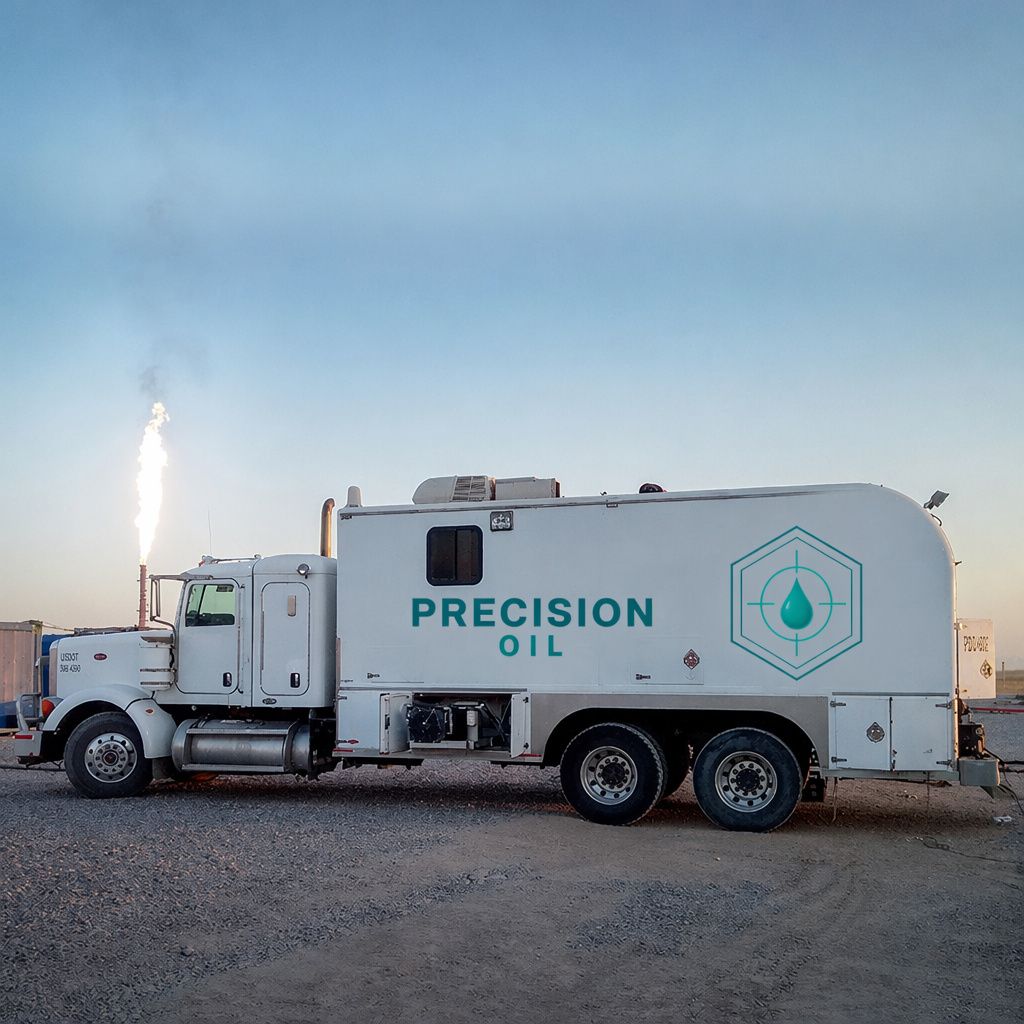
1. Sourcing the inventory
We work with independent operators who are sitting on marginal, stripper, and shut-in wells — assets that are often written off internally because they're too small, individually, to justify an operator's engineering and land overhead. In aggregate, this is one of the largest under-addressed pools of value in oil and gas: the majority of the world's producing wells are mature, and a meaningful share of their remaining hydrocarbons sits behind fixable near-wellbore damage rather than genuine reservoir depletion.
Operators bring us wells they've deprioritized. We bring the capital and expertise to find out which of those wells are worth a second look.

2. Diagnosing the well, not the symptom
Before any technology gets considered, we work to understand why a well is underperforming. Declining production can come from several different root causes, and each one calls for a different fix:
- Near-wellbore damage (scale, paraffin, clay swelling, drilling fluid invasion)
- Poor sweep efficiency or residual oil saturation left behind by primary recovery
- Rising water cut crowding out oil production
- Low reservoir pressure
- Mechanical or completion issues rather than reservoir limits at all
We pull decline curves, production history, water cut trends, and whatever pressure or diagnostic data exists, to build a picture of what's actually holding the well back — separate from what any single vendor might assume.

3. Screening across a technology-agnostic portfolio
This is the core of what makes Precision Oil different. We don't own a single remediation technology and look for wells to fit it. We maintain relationships with multiple remediation technologies, spanning different mechanisms — microbial, electromagnetic, nanotechnology-based, and others — each suited to different reservoir and fluid conditions.
Every technology in our portfolio has a defined operating envelope: the depth, permeability, oil viscosity, water cut, and formation type where it performs best. We've built a structured scoring matrix that maps each well's diagnosed problem against every technology's known envelope, so the well gets matched to whichever mechanism is the best fit — not whichever vendor got to the operator first.
The result is a first-pass filter that lets us screen many wells quickly, before committing to the cost of a full engineering evaluation on any one of them.

4. Structuring the deal
Once a well is a strong candidate, we structure a joint venture with the operator. Precision Oil funds the remediation campaign and takes on the execution risk — the operator isn't asked to spend capital on a well they'd already deprioritized. In exchange, we share only in the resulting incremental production, for a defined economic period. If the well doesn't respond, the operator hasn't paid for a failed treatment out of pocket.
This turns a well that was a cost center — or simply forgotten — into a shared cashflow asset for both sides.
5. Executing through specialist partners
We don't carry a remediation workforce. Field execution runs through the technology provider and existing operator infrastructure — equipment, personnel, and site access are coordinated for the specific job, not maintained as permanent overhead. That keeps Precision Oil asset-light: costs scale with the number of active campaigns, not with headcount.
6. Measuring the response
After treatment, we track the well against the incremental production it generates — typically over a multi-year economic participation period — confirming the diagnosis was right and the technology performed as expected.

7. Compounding the data
Every well we screen and every intervention we complete adds to a proprietary dataset: which well characteristics predict success, which technologies perform under which conditions, expected uplift ranges, and cost-to-return profiles. Over time, this improves how accurately we screen the next well — and how confidently we can deploy capital across a growing portfolio.
The wells generate the revenue. The technology-agnostic matching is what makes each well's economics work. The data is what compounds.