Enhanced Oil Recovery (EOR)
Precision Oil is technology agnostic, selecting the remediation solution best suited to each well's specific production impairment. Our independent approach enables us to evaluate a range of proven technologies and deploy the one most likely to maximise production uplift and investment returns.
The Three Phases of Oil Recovery
Oil fields are typically produced in three broad phases over their productive life: primary, secondary, and tertiary (EOR).
Primary Recovery (First Lift)
Primary recovery, or first lift, relies on the natural energy of the reservoir to drive oil to the surface. This includes mechanisms such as:
- Solution gas drive, where dissolved gas in the oil comes out of solution and expands.
- Gas cap expansion, where a gas cap above the oil expands as pressure drops.
- Natural water drive, where underlying aquifers push fluids upwards.
Artificial lift — such as pump jacks or gas lift — is often added to assist production, but in primary recovery no external fluid is injected into the reservoir to displace oil. Primary recovery typically produces:
- Oil that is already well connected to the wellbore through high-permeability pathways.
- Fluids in zones with strong pressure support and good connectivity.
Despite being the simplest phase, primary recovery usually only captures a small fraction of the original oil in place. The reservoir quickly transitions from naturally flowing to declining production as reservoir pressure drops and the easiest barrels are depleted.
Secondary Recovery
When natural reservoir pressure declines to the point that primary production is no longer economic, secondary recovery is introduced. The goal is to maintain pressure and push more oil toward producing wells.
Typical secondary methods include:
- Waterflooding, where water is injected through specific wells to sweep oil toward producers.
- Gas injection, where gas is injected to support pressure and partially mix with oil.
Secondary recovery yields:
- Additional oil from the same high-permeability pathways first exploited by primary production.
- Oil from adjacent zones that are swept by the advancing water or gas front.
However, even after secondary recovery, a large share of oil remains in the reservoir. Significant volumes of oil are left behind in:
- Lower-permeability zones and poorly connected layers.
- Regions bypassed by the flood front due to heterogeneity or poor sweep.
- Microscopic pore structures where oil is trapped by capillary forces and can't be displaced by water alone.
Together, primary and secondary phases often leave the majority of the original oil in place still in the reservoir, which is where EOR becomes essential.
What Enhanced Oil Recovery Actually Targets
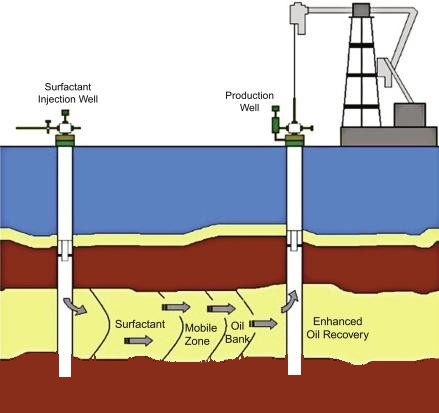
Enhanced Oil Recovery (EOR) is the set of methods used after primary and secondary recovery to mobilize and produce oil that would otherwise remain trapped. Rather than just maintaining pressure, EOR changes the properties of the fluids or the rock to unlock additional barrels.
The main EOR categories include:
- Thermal EOR — uses steam or in-situ combustion to heat heavy oil, reduce viscosity, and make it flow more easily.
- Chemical EOR — uses polymers, surfactants, or combinations (e.g., alkaline-surfactant-polymer) to reduce interfacial tension, modify wettability, and improve sweep efficiency.
- Miscible Gas EOR — uses gases such as CO₂, nitrogen, or enriched natural gas to swell the oil, reduce viscosity, and achieve miscibility, allowing trapped oil to flow more freely.
These methods are designed to recover:
- Residual oil trapped by capillary forces that waterflooding cannot move.
- Oil stranded in lower-permeability zones or poorly swept regions where conventional floods were ineffective.
While EOR can significantly increase ultimate recovery, traditional schemes are capital-intensive and complex. They require surface facilities, injection networks, long project timelines, and careful reservoir management at field scale.
The Problem: What's Left After Primary and Secondary
To understand why Electric Pulse Technology makes sense, it's critical to look at what's actually left in the reservoir once primary and secondary phases have run their course.
After primary and secondary recovery:
- The "easy" oil in the most connected, high-permeability pathways has been produced.
- The reservoir has become more heterogeneous in terms of what remains: lots of small pockets and thin lenses of oil.
- Near-wellbore regions may be damaged or clogged by scale, fines migration, paraffin and asphaltene deposition, and changes in wettability.
- Residual oil saturation remains high in many zones, especially in micro-pore systems and areas where the flood front didn't sweep effectively.
In mature wells, the bottleneck is often no longer the field-scale reservoir pressure alone, but the near-wellbore environment and fine-scale connectivity that controls how easily fluids can enter the well.
This is exactly the niche that Electric Pulse Technology is built to exploit.
How Electric Pulse Technology Works
Electric Pulse Technology (EPT) is a well-level stimulation method that uses controlled electrical discharges to generate elastic (pressure) waves in the reservoir around the wellbore.
While implementations differ, the core principles typically include:
- Low-energy, high-frequency electrical pulses delivered downhole.
- Generation of elastic waves that propagate into the rock, interacting with the pore system and fluids.
- Localized mechanical and physical effects that improve flow conditions near the wellbore.
These pulses can:
- Break up and mobilize deposits such as paraffin, asphaltenes, and scale in the near-wellbore region.
- Reduce plugging caused by fines migration, opening up clogged pore throats.
- Enhance connectivity by slightly opening micro-fractures and pathways, increasing the effective drainage radius.
- Influence fluid behavior (e.g., local viscosity, emulsions) in ways that support improved flow.
Where conventional EOR focuses on changing fluid and rock properties over the entire reservoir or across large patterns, EPT focuses on the critical near-wellbore zone that directly controls well productivity.
What Oil EPT Actually Unlocks
In the context of the three phases:
- Primary recovery extracts oil that naturally flows to the well due to strong initial pressure and high connectivity.
- Secondary recovery pushes additional oil toward the well using water or gas, but still leaves behind oil trapped in low-permeability zones and in damaged near-wellbore regions.
- EPT and similar tertiary techniques aim to unlock oil that is already close enough to the well to be produced, but blocked by local flow restrictions.
Specifically, EPT is well positioned to recover:
- Oil in the near-wellbore region that cannot flow because of damage or plugging.
- Oil mobilized by primary and secondary processes but not able to enter the well due to skin, deposits, or poor connectivity.
- Portions of residual oil in micro-scale structures that become drainable once pathways are reopened or improved.
This makes EPT a highly targeted method: it doesn't replace waterfloods, CO₂ floods, or polymer projects, but it amplifies the productivity of existing wells and leverages the energy and fluids already in the reservoir.
Why EPT Makes Economic and Operational Sense
From an operator's standpoint, the value of EPT is that it provides a tertiary-type uplift without requiring full-field EOR infrastructure.
Key advantages include:
1. Low Capital Intensity
Traditional EOR projects often require:
- New injection plants and surface facilities.
- Dedicated injection wells and patterns.
- Extensive pipeline networks and field-level redesign.
Electric Pulse Technology, by contrast, can be applied on a per-well basis with relatively modest surface equipment and short operational windows. This results in:
- Lower upfront capex.
- Shorter payback periods.
- Ability to scale treatments across a field in phases rather than committing all capital at once.
When you combine that with the reported average uplift of around 170% in production across more than 800 wells treated since 2011, the economics can be extremely compelling.
2. Fast Deployment and Flexibility
EPT treatments:
- Can typically be conducted quickly on individual wells with minimal downtime.
- Do not require changing the existing waterflood or gas injection strategy.
- Can be selectively applied to under-performing wells, high-potential candidates, or as part of periodic well-rejuvenation programs.
This flexibility allows operators to:
- Test EPT on a pilot basis, prove the uplift, then expand.
- Prioritize wells where incremental barrels deliver the highest net present value.
- Integrate EPT into ongoing workover and optimization programs.
3. Complementary to Existing Recovery Schemes
EPT is not an either/or alternative to waterfloods and other EOR processes. Instead, it:
- Enhances the productivity of wells already benefiting from secondary or tertiary schemes.
- Improves the efficiency of capital already deployed in injection systems.
- Provides a tertiary uplift lever even in fields where large-scale EOR is not feasible due to economics, infrastructure, or regulatory constraints.
In other words, it acts as a force multiplier on existing recovery strategies.
EPT is the cheapest, Proven Tertiary Lever
Bluespark positions its Electric Pulse Technology as:
- By far the cheapest technology available for this category of tertiary/near-wellbore EOR.
- Delivering an average uplift of about 170% in production across more than 800 wells treated since 2011.
- Backed by a significant operational track record across diverse reservoirs and geographies.
From a commercial perspective, this allows Precision Oil to frame Bluespark EPT as:
- A low-risk, high-reward option for mature assets.
- A method that can convert existing well stock into a new source of incremental barrels.
- A technology that fits performance-based commercial models (e.g., fees linked to incremental production), aligning incentives between operator and technology provider.
For asset managers and production engineers, that combination of low unit cost, materially higher production, and a long operational track record is exactly what they need to justify deploying a new tertiary technology.